
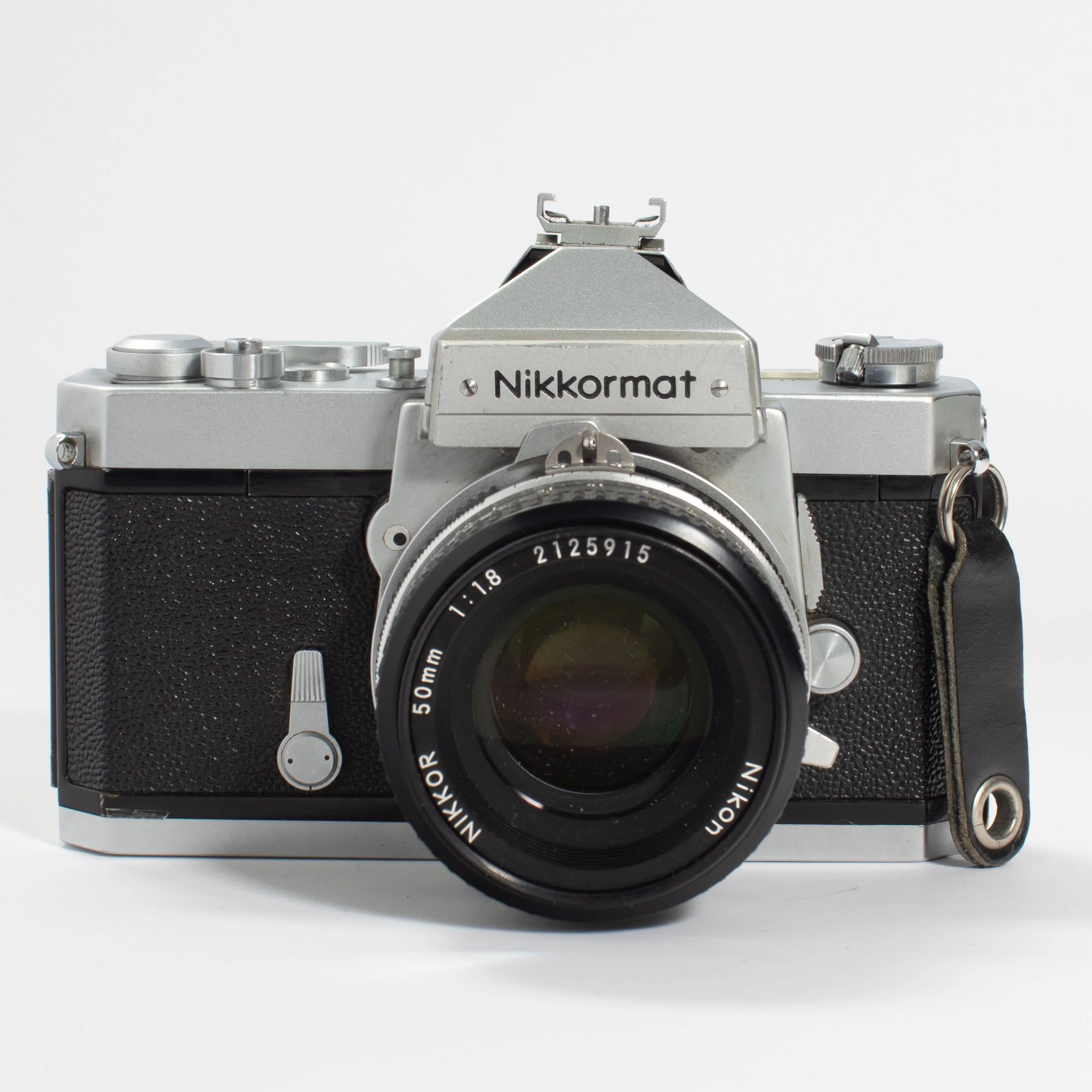
Nikon Cameras Nikkormat FT
1965
The Nikkormat FT was an all-metal, mechanically (springs, gears, levers) controlled, manual focus SLR with match-needle exposure control, manufactured in Japan from 1965 to 1967. It was available in two colors: black with chrome trim and all black. The unmetered version was designated "Nikkormat FS."
The FT had dimensions of 95 mm height, 146 mm width, 54 mm depth and 745 g weight. This was larger and heavier than most competing amateur level SLRs of the mid-1960s, such as the Asahi (Honeywell in the USA) Pentax Spotmatic of 1964, but the quality of the internal components gave the FT strength and durability.
The FT used a metal-bladed, vertical travel, focal plane shutter with a speed range of 1 to 1/1000 second plus Bulb and flash X-sync of 1/125th second. The Nikkormat F-series had a shutter speed ring concentric with the lens mount, unlike Nippon Kogaku's other manual focus SLRs with a top mounted shutter speed dial.
The FT's exposure control system was a "center-the-needle" system using a galvanometer needle pointer moving vertically at the lower right side of the viewfinder to indicate the readings of the built-in, open aperture, TTL, full-scene averaging, cadmium sulfide (CdS) light meter versus the actual camera settings. The photographer would adjust the shutter speed to freeze or blur motion and/or the lens aperture f-stop to control depth of field (focus) until the needle was centered between two pincer-like brackets. The needle array was duplicated in a window next to the top-mounted film rewind crank to allow exposure control without looking through the viewfinder. The meter was turned on by pulling the film wind lever out to the standby ready position and turned off by pushing it back flush against the camera.
This was very advanced in 1965 and proved to be remarkably long-lived. Nippon Kogaku used it for all versions of the Nikkormat FT with incremental improvements. The Nikon FM, FM2 and FM2N of the succeeding Nikon compact F-series SLRs used an improved viewfinder only, center-the-LED system until 2001.
The FT's viewfinder also had a fixed focusing screen with Nippon Kogaku's then standard central 4 mm microprism focusing aid plus 12 mm matte focusing surface.
The Nikkormat FT accepted all lenses with the Nikon F bayonet mount (introduced in 1959 on the Nikon F camera) and a "meter coupling shoe" (or prong, informally called "rabbit ears"). The FT had a mirror lockup allowing its use with some specialised lenses for which an auxiliary viewfinder was provided.
The FT was Nippon Kogaku's first SLR with a built-in TTL light meter. As such, Nippon Kogaku could not find a way to automatically synchronize their Nikkor Auto lenses' aperture information with the FT body. Therefore, mounting lenses required a special preparatory procedure. First, the lens' maximum aperture (smallest f-stop number) must be set against the film speed scale on the FT's shutter speed ring. Then, the "meter coupling pin" on the ring surrounding the FT's lens mount flange must pushed all the way to the right and the lens' aperture ring must be preset to f/5.6 to line up the "meter coupling shoe" with the pin for mounting. Note that the lens maximum aperture had to be reset every time the lens was changed. This was very inconvenient compared to some other SLRs of the 1960s.
Note that modern AF Nikkor autofocusing lenses (introduced 1986) do not have a meter coupling shoe, but all non-G AF lenses have two pilot holes to retrofit the coupling shoe, making them 100% compatible with all Nikon F-mount cameras. Although most AF Nikkor lenses will mount and manually focus on the FT, the combination cannot provide open aperture metering; only stop down metering. Nikon's most recent 35 mm film SLR lenses, the AF Nikkor G type (2000) lacking an aperture control ring; and the AF Nikkor DX type (2003) with image circles sized for Nikon's digital SLRs will mount, but will not function properly at all.
The FT also had two PC terminals to synchronize with flash units: an M-sync to all speeds for M and FP type (1/60 second for MF type) flashbulbs and an X-sync to 1/125th second for electronic flashes using guide number manual exposure control. However, the FT did not have a built-in accessory shoe to mount flash units. The "Nikkormat accessory shoe" must be screwed to the top of the pentaprism cover via the eyepiece first. Note that this shoe only mounts the flash. A PC cord must still be plugged into the appropriate PC terminal. This was normal for most SLRs of the 1960s.